



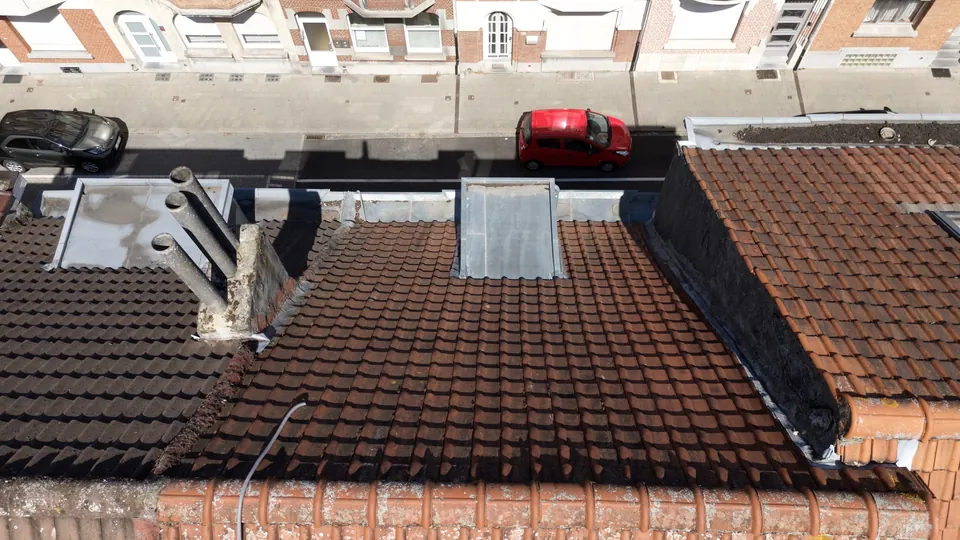
Autumn brings back strong winds and heavy rain. After a storm, the first question is usually the same: has the roof been damaged? From the street you only see part of the roof, and climbing up on a wet roof to check for yourself is dangerous. A drone inspection lets you assess the damage in a few minutes, without a ladder or aerial lift, and keep dated images for your insurer.
What damage can a drone spot after a storm?
The drone flies over the roof and the upper parts of the building and brings back high-resolution photos and video. They reveal displaced, broken or missing tiles and slates, gutters and downpipes torn off or blocked by leaves and debris, weakened chimneys, stacks and ridges, and lifted or torn flat-roof membranes.
It also shows damage caused by trees, such as a branch that has fallen on the roof, and the condition of solar panels, roof windows and technical equipment fixed at height.
Why inspect quickly?
Limiting the damage. A missing tile or a torn-off gutter lets water in at the next rainfall. Spotting the problem fast means you can have it covered or repaired before moisture reaches the insulation, the roof structure or the ceilings.
Staying off the roof. After a storm, roofs are slippery and sometimes unstable. A drone avoids unnecessary risks, for you and for a tradesman who would come "just to have a look".
Getting repairs priced remotely. With clear images of every affected area, a roofer can prepare a more accurate first quote, and you can compare several offers on the same basis.
What to do while you wait for the inspection?
A few simple steps already help. Keep clear of areas where a tile or a piece of gutter could still fall, in front of the facade or in the garden. Inside, check the ceilings under the roof, the attic and the walls of the top-floor rooms: a damp patch or a drip often shows where to look. Take your own photos of these marks with your phone and note the date. And if the wind has carried something off, a branch or part of a neighbouring roof, photograph it where it landed before moving it.
Useful images for your insurance claim
After damage, your insurer will ask you to describe and prove what happened. Sharp, dated photos taken shortly after the event clearly show the condition of the roof and the extent of the damage. They support your claim and make discussions with the loss adjuster easier. Remember to report the damage promptly, within the deadline set by your policy, and keep these images together with your repair invoices.
For property managers and co-owners, an inspection after a storm is also a quick way to inform everyone in the building. We cover this in our article Drone facade inspection.
How does an inspection with Skydrone work?
You request a quote through the form on our website: we reply within 48 hours and the quote is free. We check the flight zone and handle the necessary authorisations, especially in Brussels (see Can you fly a drone in Brussels?). We fly as soon as the weather allows a safe flight, since a drone does not fly in heavy rain or strong wind. On the day, we photograph and film the roof, the facades and the affected areas, both overview and detail shots. You then receive the images via WeTransfer or Google Drive, sorted by area, ready to send to your insurer or roofer. To compare with other methods, also read Drone or aerial lift roof inspection.
Was your roof hit by the last storm? Request your free quote, reply within 48 hours.